License to kill spells trouble for sea lions

Well it’s official. 113 is the new kill quota for our threatened New Zealand sea lions – a 40% increase on last year’s quota. Set by the new Minister of Fisheries Phil Heatley, the quota determines how many sea lions the Auckland Island squid fishery can kill in the 2009 fishing season.

Once prized for their blubber, New Zealand’s sea lion population was massively depleted in the 1800s due to hunting.  Today their population stands at only 12,000 individuals, most of whom live around the remote offshore Sub-Antarctic Islands.

In 2008 the species was relisted by the IUCN on its Red List of species threatened with extinction recognising a 30% decline in pup births over the last decade.

Disease epidemics in 1998, 2002 and 2003 killed a huge number of sea lions. But these are thought to be natural events. Death in our fishing nets is not.

The Auckland Island squid trawl fishery is one of a number of fisheries operating around the Auckland Islands that kill sea lions. However, unlike other fisheries it is responsible for the majority of deaths because its operation lies within the feeding range of nursing and pregnant female sea lions.

Unborn pups follow the fate of their pregnant mothers, and pups left onshore starve, greatly increasing the death toll.

Diagram of a SLED
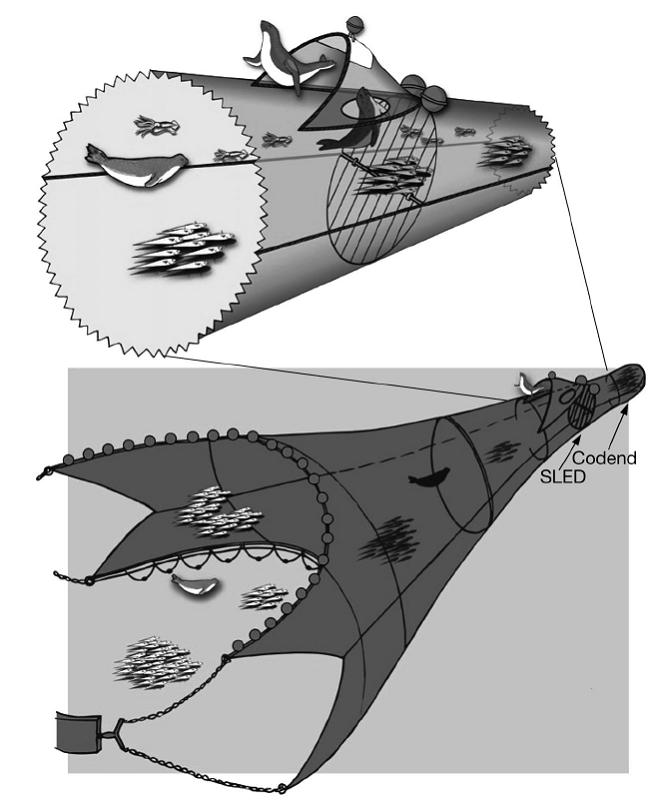
Sea lion exclusion devices, or SLEDs, were trialled in the squid trawl fishery in 2001. And despite limited information on their effectiveness, they are now used across most of the fleet. In theory, they sound very good but in practice sea lions are still being caught and killed every year and we still have no information on whether NZ sea lions survive once they exit from the SLEDs.

The Minister claims he made a conservative decision. In the face of the available information however, does a 40 per cent hike in the sea lion kill quota really constitute conservatism?

Picture sourced from the Endangered Species Research Journal

To find out how many sea-lions have been killed this season (08-09) click here.

« High country holidaying | Wanderings and Wonderings on Whenua hou Part III »

11 Comments

Leave a comment »

  1. January 7, 2009 1:56 pm
    Anne says

    If that’s conservative, I wonder what his definition of radical is? On second thoughts, maybe we don’t want to find out!!
    Anne

  2. January 7, 2009 3:49 pm
    chris henderson says

    It is obvious”sqidsin”…
    This fishery will now have even more blood on it’s hands
    How will the Minister explain this rationale to the world?
    So much for sustainability, biodiversity protection and our ‘Clean, green image”, critical for our survival, marketing our produce, and for tourism
    Will this decision please the Prime Minister?
    It shouldn’t.

  3. January 7, 2009 4:39 pm
    Suzi says

    It’s a crying shame (but no surprise), that this government will not adequately protect our endemic sealions. This kill quota is unacceptable and all NZers who care about our marine mammals should be protesting and calling for a reduction in the quota, starting with their local MPs.
    Agree with your comments Chris (and congrats on gong!), especially re our international reputation. How will this government defend such a policy on the international stage ? How can we condemn Japan’s appalling performance on whaling when we allow the slaughter of our own endemic sealion ?? Time for more protext action.

  4. January 7, 2009 8:41 pm
    Carole Long says

    And we criticise the Japanese for killing whales! This is no surprise from a Government whose party policies are based on money and markets. As technology improves for increasing the catch, so the money should be spent on limiting sealion deaths and if the rules are in place and strongly monitored (by whom?) there is a motive for industry to meet a low or nil target for sealion kills.

  5. January 8, 2009 1:54 pm
    ChrisB says

    Maybe the Sea Shepherd could take a rest from chasing those whalers and cruise on down to the Auckland Islands and start giving those squid boats a bit of a rev-up?

  6. January 15, 2009 9:29 am
    Grrrover says

    NZ marine mammals such as the NZ sea lion and Hectors dolphins are under greater threat than whales, so why are most NZ conservation organisations and politicians so vocal about whales, yet silent about our own endemic marine mammals that are being killed in the name of making money? Good on Forest and Bird for speaking up about all marine life and not just the ones that provide easy PR opportunities. And boo to you Mr Heatley!

  7. February 13, 2009 11:31 am
    Johan says

    I wrote to the Minister to express concern about this (as invited by F&B) and got the following (standard?) reply:

    “Dear Johan
    Thank you for your email expressing concern about my recent decision to set the sea lion limit in the squid fishery at 113 sea lions.
    In making this decision I am required by law to consider both the utilisation of the squid fishery and the likely environmental impacts of that activity. My decision took into account all of the available information on the sea lion population. Although recent science gave me a range of plausible options, right up to 249, I was conservative and set the fishing related mortality limit (FRML) at 113 sea lions only.

    I am aware of the on-going concerns around the current sea lion population size and because of this I chose a sea lion limit at the conservative end of the range available to me. I believed exercising caution when setting this limit was warranted.

    Recently the Department of Conservation announced a decline in sea lion pup numbers. I am pleased to advise you that the fishing industry has responded proactively to the decline by agreeing to reduce their fishing effort in the squid fishery for the 2009 fishing season, effectively taking the FRML from 113 to 95. I support and congratulate the industry for taking this responsible and cautious approach.

    The fishery is intensively monitored. I will not hesitate to close the SQU6T fishery if the FRML is reached.

    Further information on my decision and the management of the squid fishery can be found on the Ministry of Fisheries website at http://www.fish.govt.nz.

    I would like to thank you for taking the time to contact me on this important issue. I appreciate the concerns you have about the impacts of fishing activity on sea lions. I can assure you that I will continue to support all efforts to reduce the impact of fishing on these important marine mammals.

    Yours sincerely

    Phil Heatley
    Minister of Fisheries”

  8. February 13, 2009 11:43 am
    Kirstie Knowles says

    For your information, the 246 figure quoted is not in fact an upper limit agreed as being viable. Originally, in the draft paper, the upper limit was around 140. Numbers seem to change left right and centre in this game. Reason being, there are HUGE problems with the model used to come up with these numbers, not least it massively overestimates the number of sea lions born each year.

    As the Minister notes, this summer has seen a 30% reduction in the number of pups born - that 600+ animals – both dead and alive. This is massively lower than ever predicted. As a result, the fishing industry volunteered to kill 20 less sea lions. The minister has not made a decision, he just patted the industry on the back. It is now this new figure of 95 that the Minister is using this season. The figure (95) is still 17% greater than last years kill quota.

    Whilst Forest & Bird welcomes the reduction as a move in the right direction, it is not enough to meet the Minister’s obligation under the Fisheries Act. As such we have written to the Minister and continue to encourage members and the public to voice your disapproval.

    Thank for supporting us on this issue Johan and for working with us to improve the conservation status of New Zealand sea lions.

  9. February 16, 2009 11:56 am
    Johan says

    Kristie,
    Could you also do a post on the Hector’s and Maui dolphins at some stage? It will be interesting to see what their status is.

  10. December 22, 2009 11:15 am
    Andrew says

    Kristie,

    I’m just wondering if you could be a little more truthful in your description of the so called ‘kill quota.’ I’m sure you are well aware of how this quota is set. I.e they use computer modelling based on population and recruitment estimates to see what the maximum annual impact of from fisheries can be without causing significant decline.

    This figure is then set to a number of tows using a ratio. So if it is 0.4 sea-lions per tow and the kill quota is 100, that means 400 tows will be allocated for the squid fishery that season. The use of SLED’s does not allow them to kill more sea-lions, it allows them more tows.

    “Four sea lions have been reported as accidentally killed by fishing vessels this season (2009), two from vessels carrying a Ministry of Fisheries observer and two from unobserved vessels” Mr. McNee said. So I’m not sure where the figure of 72 sealions that is on the website comes from?

    “This season’s current figure of four deaths comes from over 1900 individual trawls. Last season there were five reported accidental deaths from 1250 trawls.” Again, nine sea-lions in two years killed in the squid fishery.

    I’m glad for you to point out to me where I’m wrong. I’ve supported F&B in the past, but this kind of sensationalist nonsense is a real turn off. By all means sea-lions and other marine creatures need to be conserved and the situation really isn’t that bad, but we shouldn’t be bending the truth or telling lies in order to gain more support. Because when you get called out, all integrity is lost. And integrity is one thing we should always hold over governments and big business.

  11. December 27, 2009 6:48 pm
    Kirstie says

    Andrew. You are absolutely right. The estimation of the number of sea lions killed in the southern squid trawl fishery comes from a ‘pre-determined strike rate’. An estimate. This estimate is then multiplied by the number of tows conducted by the fishery.

    The number killed has to be estimated this way because since the use of SLEDs, we have no idea how many are actually harmed - sea lions may be ejected from the SLEDs and their status / survival unknown.

    Last fishing season the squid trawl fishery was estimated to kill 72 sea lions - using this method. Up on the estimate from previous years.

    What you may or may not be aware of however, is how much of a complete nonsense the whole thing is.

    As the fishery is effectively restricted by the number of tows it conducts, the industry’s response has simply been to extend the duration of each tow - thereby avoiding the intended restriction of the number of sea lions subjected to risk of death.

    Re. the model used in estimations, one of the key critisisms of the management of this fishery and the sea lion deaths is the HUGE uncertainties in the model used to test management goals. Last year DOC recorded a scary 31% drop in the number of pups born. The model was far off estimating this and had to be corrected. Many other assumptions are also questioned.

    The model itself is good. But the assumptions and use of the model are highly problematic and far from cautionary.

    Forest & Bird argues that given the declining status of NZ sea lions - a drop of around 50% in pup numbers (alive and dead) since 1998 - extreme caution is needed.

    Forest & Bird are on the working group to try and improve efficiency of SLEDs but continue to be frustrated with the lack of progress, the failure to uptake needed improvements and the biased reporting of their effectiveness.

    Setting of a fishing related mortality limit or ‘kill quota’ as we call it is effectively a licence to go out and knowingly kill these animals.
    IT is not being emotional it is simply fact.

    Whilst recognised as ‘accidental’, sea lions are killed every year in the Southern squid trawl fishery (and a number of other NZ fisheries). Setting a limit on the number allowed to be killed confirms this.

    Hope this goes some way towards answering your concerns.

    Forest & Bird is NOT about sensationalism - we ARE all about facts.

    The estimate of 72 last season came from the number of tows carried out by the fishery - a massive increase on the previous two years, despite the alrming drop in the pup numbers and ongoing decline of the species.

    Happy to explain more if you’d like me to. Perhaps the best way to follow our position and understand the complexities involved in the current management systems is to read our recent submission on the 2010 Operational plan and “kill quota”.

    It is not yet uploaded onto our website, but you can find our submission for last year’s plan here: http://www.forestandbird.org.nz/what-we-do/campaigns/save-our-sea-lions

    Cheers

RSS feed for comments on this post. TrackBack URL

Write a comment

HTML is disabled, but URLs will be auto-linked. Your e-mail address won't show up on this page. Please note that all comments are moderated prior to publication.

* Required field