
Wanderings and Wonderings on Whenuahou
I write this diary from the Sealers Bay hut, Codfish Island, Whenuahou. I have just arrived on this beautiful 1396 hectare nature reserve which lies to the north west of Stewart Island, in the most celebratory fashion. I was flown in on a fixed wing light aircraft across the Foveaux Strait which homed in on a magnificent landing on Sealers Bay beach. I hadn’t known what to expect of Cod fish Island but the sight I beheld surpassed my wonderings and wanderings.
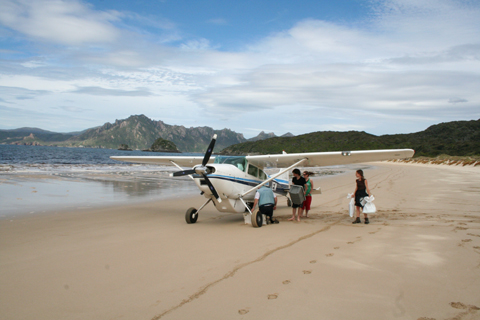
Photo: Tama Pugsley
Sealers bay is a kilometre long white sandy beach, consolidated by perfectly formed sand dunes that rise towards a coastal ridge. Behind this ridge, flowing forest laden slopes arise from which, native bird song emanates. Looking north from the beach is the magnificent view of the Ruggedy mountain range which are situated in the Northwest corner of Stewart Island. These stunning jagged peaks were uplifted from the sea approximately 130 million years ago.
I have arrived with two others at this haven with a specific and single purpose; to volunteer in the Department of Conservations Kakapo Recovery Programme as a supplementary feeder. No visitors are allowed without a permit. Having entered the kakapo’s domain, I am beginning to get to know them on a first-name basis – all 75 known kakapo on the island have been named.
The Kakapo Recovery Programme was initiated by DOC in 1987 and its purpose is to prevent extinction of New Zealand’s critically endangered Kakapo. In 1990, Rio Tinto Alcan New Zealand Limited became the major sponsor of the Kakapo Recovery Programme in Partnership with DOC and Forest & Bird under the auspices of the Threatened Species Trust.
The Kakapo is a species of nocturnal parrot with finely blotched yellow-green plumage endemic to New Zealand. It has a distinct facial disc of sensory, vibrissa-like feathers, a large grey beak, short legs, large feet, and wings and a tail of relatively short length.
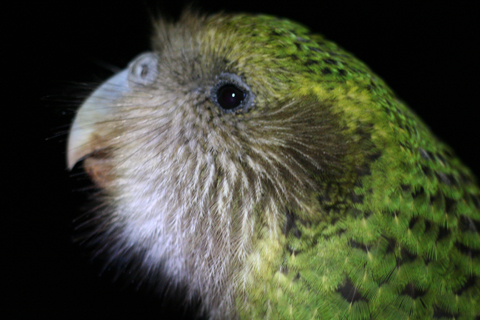
Sirocco, photo: Tama Pugsley
A certain combination of traits makes it unique among its kind—it is the world’s only flightless parrot, the heaviest parrot, nocturnal, herbivorous, visibly sexually dimorphic in body size and is the only parrot to have a polygynous lek breeding system. It is also possibly one of the world’s longest-living birds.
The traditional diet of kakapo is strictly herbivorous and includes the fruits, seeds, bark, bulbs, leaves, stems and roots of lots of native plants. On Whenuahau, it is boosted with a special pellet, which is part of the supplementary feeding programme provided to keep the birds in good reproductive condition, and help produce more eggs in breeding seasons. During breeding, the pellets will also help mothers raise their chicks if rimu fruit is in short supply.
I certainly feel very lucky at this moment, to have this opportunity to assist in this worthwhile cause and make sure the birds are in good condition for their upcoming breeding season. I will keep you posted with my progress and any meetings with feathered friends!
