
The Demise of Juan Carlos and his Feathered Friends
Guest Blogger: Jenny Lynch, Places for Penguins Co-ordinator
Those of you who live in the Wellington area may have heard of the hit and run death of Juan Carlos in Karaka Bay. Juan Carlos was a little blue penguin befriended by a local resident, Pelayo Salinas de Leon.
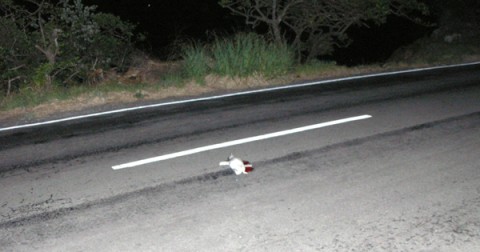
RIP Juan Carlos
Pelayo would watch the little blue come from the sea, across the road and into the vegetation behind his house each night. Then one night Pelayo heard a car coming down the road followed by frenzied penguin sounds and an ominous thump. Going outside to investigate he found Juan Carlos dead, lying in the middle of the road with the offending vehicle nowhere to be seen.
Juan Carlos is not the first little blue to meet this fate and undoubtedly will not be the last. Little blue penguin habitats all around New Zealand are bisected by coastal roads, forcing these tiny 35cm high birds to cross the road to get access to suitable burrows. The fact that they come ashore at dusk and leave again around dawn makes it even harder for drivers to see them. Add to this the fact that little blues, like many native species, are subject to predation, habitat loss, competition for food and marine pollution and things are certainly looking blue for the world’s smallest penguin.
But what’s the solution? Speed bumps can slow down cars in certain areas where penguins cross but it can be difficult to get these put in place. Wildlife underpasses have been used overseas with some success for other species that have faced similar problems. In the Netherlands, a network of 600 tunnels under both major and minor roads has help increase the population of the endangered European badger. Whilst incorporating wildlife underpasses into new roads has been shown to not increase the overall cost of roading by a large amount, building them under existing roads appears to be much more costly. Studies have also shown that usage of wildlife underpasses is also very dependent on species, habitat, location and structure. Build it but they may not come.
At present community education about threats to little blues is one of the most common tools used to protect little blues around the country, along with the positioning of nest boxes to provide safe nesting sites, planting of penguin friendly coastal plant species and predator control. Places for Penguins is a project run by the Wellington branch of Forest & Bird and is developing a coastal site at Tarakena bay using these methods.
Many people I ask don’t even know that little blues live in Wellington because they are only onshore at night. How can we raise awareness of little blue penguins in the communities where they live to prevent them being hit by cars, attacked by dogs or eating rubbish discarded in the ocean?
P.S For a video account of what many little blue penguins go through every night as they cross the road – check out the video below –
