
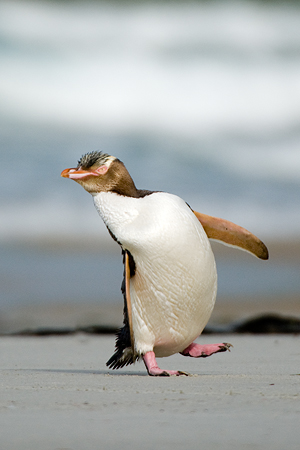
Not so happy feet?

Yellow eyed penguin, Andrew Walmsley

Yellow eyed penguin, Andrew Walmsley

Guest blogger - Photographer, Tom Marshall

A comment my colleague and I often get as New Zealand photographers is ‘you must have had a wonderful time in Antarctica’. As much as I’d love to say ‘yes, it was awesome, but a bit chilly’, the truth is we’ve never set foot south of Dunedin and people are usually looking at our pictures of Fiordland Crested or Yellow-eyed Penguins.

Now I love ‘Happy Feet’ and ‘March of the Penguins’ with their iceberg-strewn backdrops as much as the next person, but it’s surprising how few people realize that we have some of the most amazing – and rarest penguins on the planet are right on our doorstep.

Christchurch Mayor Bob Parker said recently of a new tourism drive ‘I doubt tourists will want to come to the South Island just to see a penguin’ – but why not? From recollection they were fairly thin on the ground north of the equator last time I was there, and with a million birdwatchers in the UK alone, I’m sure there’s plenty of people who’d willingly put up with the West Coast’s finest sandflies for a glimpse of a Fiordland Crested Penguin in his dapper dinner jacket.


Indeed, if current research is to be believed we should be making the most of these opportunities while we still have them, with the Eastern Rockhopper Penguin of Campbell Island declining by a staggering 94% percent since the 1940s.

Our mainland penguins are not faring much better, with factors such as habitat loss, introduced pests and un-managed human disturbance – especially dogs, all affecting yellow-eyed, Fiordland and little blue penguin populations. Although typically shy species, a number of conservation groups and committed individuals are giving people the chance to see these iconic birds, whilst allowing the penguins to get on with life’s other challenges like avoiding sea-lions and rock climbing.
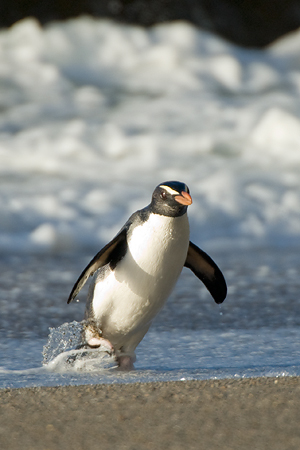
Yellow eyed penguin, Andrew Walmsley

Fiordland crested penguin, Andrew Walmsley

We can certainly help by not disturbing the penguins as they go about their daily lives, but bigger factors such as climate change and the potential effects on sea-surface temperature and therefore the availability of prey, is something we all have to consider as it begins to affect seabirds across the world from New Zealand to tiny Scottish Islands.

So next time a friend is showing you the brochure for the latest luxury Antarctic expedition, why not suggest a few days visiting New Zealand’s own cast of ‘Happy Feet’, and take the chance to see these superb birds in our own backyard – and without the extra thermals.

Images by Andrew Walmsley – www.wildfocus.org

« The Story of Stuff | My life as a keaologist »

4 Comments

Leave a comment »

  1. May 25, 2009 4:55 pm
    Jocelyn says

    Nice pictures! There’s something quite adorable about penguins, I think it’s the way they waddle along like toddlers. Your photos captured this perfectly.

  2. May 27, 2009 2:52 pm
    Wendy Cain says

    This area is right up at the top of my list!
    Wendy - Auckland

  3. May 28, 2009 9:52 am
    Gerry McSweeney says

    Good on you Tom.

    I agree totally with what you say. I came here to Lake Moeraki, South Westland in 1989 to set up the Wilderness Lodge because I was passionate about saving the rainforest and saving Fiordland Crested Penguins, Tawaki. The local policeman Roger Millard described to me finding 30 penguins killed on a nearby beach by a fisherman’s dog while the fisherman was concentrating on his fishing. It seemed that everyone felt it was OK to take their dogs onto the beach in the penguin areas. Under the Wildlife Act an offence wasn’t committed until the penguin was actually dead. We spent many months researching how to get dogs banned from our South Westland coastline. In the end we discovered that if an area becomes a Wildlife Refuge under the 1953 Wildlife Act you can set in place enforceable regulations that ban dogs. It took 4 years and a public process to get this through. There was some aggro from locals and surprisingly from some DOC staff who loved taking their black labradors with them everywhere!. Finally in 1994 we got a Wildlife Refuge established for the two accessible strongholds of Tawaki; Jacksons Bay and the Moeraki coastline. Enforcement was initially hard and we helped DOC with several prosecutions as witnesses to the offences. Eventually the message got out that the ban was serious and was being enforced by the locals. We have had very few problems in recent years.The local community is now very proud that we are the guardians of what many call the world’s rarest penguin, the Tawaki

    It is one small way that ordinary people can help save penguins.

    Two lessons from this are
    1. DOC has to be prepared to be tough. Set clear laws in place, enforce them and be prepared to go to prosecution to uphold them. There is a general gutless attitude prevailing in DOC these days that ‘enforcement is unpopular” therefore they don’t like to do it and fall back on the gutless approach of saying they will put their efforts into education only. It isn’t enough because you talk to lots of the fishermen and people who take their dogs into these colonies and they’ll tell you “My dog wouldn’t harm a flea”…don’t believe it. It only takes a few minutes and lots of penguins will be dead.

    2. Why on earth havn’t we got coastal communities throughout NZ who care for their penguins–these are mostly blue penguins–campaigning for more coastal wildlife refuges that prohibit dogs. It is one straighforward and commonsense way we can help the penguins.

    Every time I see reports of another group of penguins being killed by dogs I despair. DOC could take the lead and show communities how to get Wildlife Refuges. Maybe Forest and Bird should do it?

  4. August 4, 2009 11:19 pm
    Mark Ayre says

    If only people could understand what an industry bird watching is overseas. I guide for a nature tour company and each year lead a group of bird watchers around our wonderful country. These people come to NZ to see your native and endemic birds. Penguins are always close to the top of their lists ! Look what the Penguins have done for Oamaru, that is great success story.

RSS feed for comments on this post. TrackBack URL

Write a comment

HTML is disabled, but URLs will be auto-linked. Your e-mail address won't show up on this page. Please note that all comments are moderated prior to publication.

* Required field