
Kai-to-go for Kakapo: Part 1

Guest Blogger: Kakapo feeder, Stephanie Gray

By the look of the empty feed bowl, Sinbad enjoyed his  kumara cubes and macadamia nuts last night.
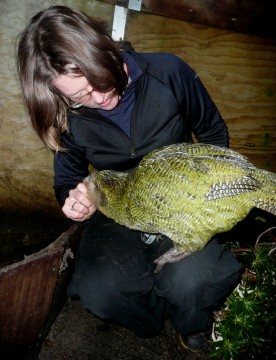
Kakapo feeder Stephanie Gray gets to know one of the juvenile kakapo on Codfish island

Kakapo feeder Stephanie Gray gets to know one of the juvenile kakapo on Codfish island

He’s tidy too, leaving only a few crumbs, unlike the chicks who scatter lumps of pasty, half-chewed pellets up to two meters from their hopper—a kakapo feed station. I start to wipe down the hopper when, with a rustle of leaves and little grunt, Sinbad pokes his head through fern fronds.

The feed-out map and guide I carry mentioned that this particular bird may be roused from daytime slumber to visit, but I’m still taken aback at the sight of this beautiful, inquisitive creature. Sinbad ambles past again, lifting huge clawed feet high above the muck of peat mud and I blurt “Sinbad, you’re amazing. I love you.”

Sentimental, yes, but I’m far from the first human to fall for the mossy green and gold kakapo. Naturalist and author Gerald Durrell once expressed the hope that if he went to heaven he hoped to find “a troop of kakapo to amuse me in the evening instead of television.”

I’ve the good fortune to be stuck in the mud with the world’s largest and most endangered parrot as a Wellington Zoo volunteer on Codfish Island (Whenua Hou). Volunteers support the year-round work of the National Kakapo Team and I’m here to help with the supplementary feeding that the team hope will trigger increased breeding.

I was up with the sun this morning to help Errol feed the last three chicks in the holding pen near the hut. The fully-feathered youngsters are keen for a feed before settling down to sleep the day away, and as Errol crop-feeds one chick, another clambers onto my knee to gently chew my fingers.

That morning I set off for the summit side of the valley to loop around seven hoppers. At each, I disinfect all surfaces, swap an empty hopper for one filled with a weighed portion of pellets moistened with flaxseed oil, and painstakingly scrape every mushy crumb of food from the ground. Cleanliness is crucial—kakapo are vulnerable to respiratory illness that may be caused by mould, and no risks are taken.

Half-way through my loop I meet up with Steve and Dana, who with VHF antennae, scales and admirable fitness, are on this side of the island to catch and weigh four recently-released juveniles.

I tag along for an afternoon of what Steve later describes as “epic bush-crashing”. Off the track to find the birds in the logs and hollows they nestle in during the day, we weave our way through webs of supple-jack—the masses of thick vine lassoing packs and limbs.

In the bush, with kaka and kakariki raucous overhead, we hear a helicopter announcing the arrival of three new birds from another island, among a load of medical supplies, groceries and a new computer.

The groceries supplement an impressively stocked larder; it’s my turn to cook tonight and I’ve spied the cashew nuts that will top off a tofu and udon noodle stir-fry. So I better get cooking! Part II to follow in the next few days…

« Clean, green, beer-making machine. Yeah right. | Kai-to-go for Kakapo Part II »

14 Comments

Leave a comment »

  1. August 10, 2009 8:49 pm
    Denise says

    Go for it Stephanie - great work. Zoo trustees are enjoying your reflections on life with kakapos.

  2. August 11, 2009 3:54 pm
    Jessica says

    Good work Stephanie.
    It’s awesome to read your blog about these wonderful birds and the work of the National Kakapo Team, with the support of volunteer’s like yourself.

    Without this dedication, the possibility of these beautiful parrots becoming extinct is a frightening prospect.

  3. August 14, 2009 9:36 pm
    CHI straightener says

    It’s awesome to read your blog about these wonderful birds and the work of the National Kakapo Team, with the support of volunteer’s like yourself.

  4. August 16, 2009 11:28 pm
    V says

    I hope that you saved some cashews for Sinbad…..

  5. August 17, 2009 9:19 am
    Ariel says

    Thats amazing!! I love the kakapo and really want to save them! And i want to be an ornithologist someday!!!

  6. September 8, 2009 12:11 pm
    Tom and Samuel says

    We really liked your blog Stephanie. We wish we were in your shoes because we love kakapo and we want to help save them so we can get them into the south and north islands.

  7. September 9, 2009 11:58 am
    Lisa says

    Keep looking after the kakapo, and other birds, Stephanie!
    It’s an awesome job you’re doing.
    My class is focusing on the kakapo at the moment so your blog really helps!

  8. September 9, 2009 12:12 pm
    Lyneesha and Analeigha says

    Hi Steph we really like your blog too. It has really cool info. We also like what you’re doing for all those Kakapo’s too and we just want to say YOU’RE ABSOLUTELY BRILLIANT!

  9. September 9, 2009 12:19 pm
    Rebecca says

    I wish I could go to Whenua Hou and see all the Kakapo every single day.You’re doing a really great thing and I think that looking after Kakapo would be a super fun job!

  10. September 9, 2009 12:27 pm
    Evan says

    I think you are very lucky to be a kakapo feeder. I wish I had your job. I want you to understand that feeding one kakapo can change the whole species.

  11. September 11, 2009 11:38 am
    Jayme says

    Your blog is really cool to read I wish I could go to Codfish Island (Whenua Hou) and clean and feed the Kakapo it would be a really great experiance. And its a great thing that your doing for the Kakapo!!! Hopefully one day they won’t be endangered any more!!!

  12. September 11, 2009 11:38 am
    cameron porter says

    I thought your blog was great! You should be proud that you’re trying to help our native birds.I would love to feed a kakapo!

  13. September 11, 2009 11:55 am
    nicola says

    I really like your blog. it must be awesome working with all the kakapos!

  14. September 11, 2009 12:10 pm
    Emma says

    I love all the things your doing.Your sooooooo lucky to be able to work with the Kakapos!!!!!!

RSS feed for comments on this post. TrackBack URL

Write a comment

HTML is disabled, but URLs will be auto-linked. Your e-mail address won't show up on this page. Please note that all comments are moderated prior to publication.

* Required field