
A weighty issue

Guest Blogger: Bev Woods, Secretary for the Northern Branch
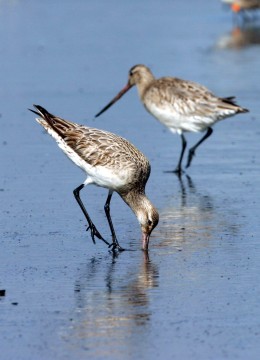
Godwits on Manawatu Estuary

Godwits on Manawatu Estuary

As many of you will know, our bar tailed godwits are fattening up for their 11,500 kilometre trip to the Alaskan-north, and will depart anytime in the next few weeks. Packing on an estimated 50% of their body weight in fuel, the birds are currently in the throes of what is best described as a feeding frenzy.

However, their attempts to pile on fat is being thwarted by a group of kite-surfers who race through their resting and feeding area, causing them to take flight and use up valuable fuel.  This situation is set against a gloomy international picture in which habitats of godwits are shrinking. The drainage of wetlands, and the discharge of toxic discharges are just some of the reasons they have fewer and fewer spots to feed and rest-up. Two years ago, around 6000 godwits came to the Whangarei Harbour habitats. This year there have been only around 3000.

During king tides in the Harbour all the godwits come to the exposed sandbar in Ruakaka Wildlife Refuge.However they are often found jostling for space with kite surfers, who are not subject to the 5 knot rule when within 200 metres of the beach (unlike jet skiers & boaties). Given that there’s a perfectly suitable kite-surfing beach 50m from this estuary, it seems strange there isn’t a blanket rule that prohibits these kite-surfers from this important bird area. It is a habitat for many species including not only godwits, but also oystercatchers, gannets, terns and NZ dotterel.

We need action, and we need it now.

« Lifeline for our Longfin Eels | The Demise of Juan Carlos and his Feathered Friends »

11 Comments

Leave a comment »

  1. March 10, 2009 2:56 pm
    Dibs says

    Horray the godwits, they are so cool!

  2. March 10, 2009 3:19 pm
    Skylark says

    “We need action and we need it now”? WHat’s that supposed to mean?

  3. March 10, 2009 3:29 pm
    Spots McKenzie says

    Maybe shoot the kite surfers out of the sky?
    Or just be respectful of our feathered friends!

  4. March 12, 2009 9:33 am
    JamieS says

    Have you tried any sort of education programme or talked to the kite surfers, and tried to work out some solutions - like seasonal restrictions on use of the area etc.

    Heres an idea for action: Try and find some kite surfing manufacturer to sponsor the godwits, they could use the godwits massive pilgrimage and beauty and toughness in their branding and through this work in kite surfing communities to develop practices that minimise impacts to birds, and even sponsor some research or other habitat based work.

    The kite surfers I know aren’t bad people. But like most outdoors people (including birders) they are individuals who make decisions on evidence and respond better to this freedom than to “blanket rules”

  5. March 12, 2009 9:46 am
    Susan P says

    I think you’re right - possibly the money could go into signage, that educates our kite-surfers about the godwits feeding habits/patterns.

    Breeding a respect for these wonderful aviators is the way to go!

  6. March 12, 2009 10:15 am
    Jas says

    Working with the kite surfing community is a great idea. It is quite possible that they are just not aware of the impact they are having on the godwits. It may seem obvious to those of us who are into conservation but to them they may just be another bird.
    Approaching them in a positive way and with suggestions of reasonable alternatives that allow them to continue kite surfing without harming the godwits and other shorebirds would be a step in the right direction.

  7. March 12, 2009 12:56 pm
    Bev Woods says

    Thanks for all these ideas. At the moment the local DC is proposing to make a safety zone excluding all similar sports from Labour weekend to Easter weekend. The zone would include the godwits area - being discussed on April 22nd. Kite surfers reactions vary - one I talked to actually worked in a National Park and didn’t see any ecological relationship between his work and his impact on the birds in the Refuge. Our group has spent at least 3 years defending breeding, resting and feeding places of the birds to no avail.

  8. March 12, 2009 1:50 pm
    Biggles says

    I think if people were more aware they might change their behaviour.I like to hope that people aren’t that horrible that they will deliberately harm wildlife. But maybe I am just being naive?

  9. March 17, 2009 1:10 pm
    Roger says

    Erm yes u probably r being naive, u only have 2 go 2 your nearest beach 2 c the sort of moronic behavior & total disregard for the wellbeing of the environment & wildlife 2 c that humans - or at least a lot of them - really don’t care less, so thats what u r up against. Sorry 2 sound cynical but its true.

  10. March 19, 2009 11:56 am
    David Kay says

    Even though it is a young sport Kiteboarders have been living and riding in the Ruakaka area since 2000. Over this time the number of riders has grown, but still is relatively small with 10 local riders and a similar number based in Whangarei that drive out when conditions are right.

    Kiteboarding has a very low environmental impact; it uses very little equipment, doesn’t burn fuel and makes no noise. Many of us choose this sport over the likes of wakeboarding or jet skiing for just these reasons. We also have little interaction with other beach users, as we require around 12knots of wind to start riding and prefer 18knots. Most beach users will know it is very unpleasant to fish, swim or kayak on any beach that has a stiff on-shore breeze blowing.

    Ruakaka river mouth is a very special riding environment for kiteboarders, with the enclosed water way giving smooth water, the outer bar giving us clean waves all the while being open to the strong winds we enjoy. This location is not just ‘some place to ride’ it is in fact a world class, best you can get type of location – not unlike Shipwreck bay in Ahipara is for surfers.

    However to Kiteboard at Ruakaka River mouth we require both a high tide and a moderate to strong Easterly wind. In any given year the total number days Mother Nature gives us with just these right conditions are around 25. On these 25 days we will average 3 hours of ridable time before the tide drops. Given an average of 12 hours of daylight per day, 365 days in the year, kiteboarders can use this location less than 2% of the time. For the other 98% of the year we simply go to beaches better suited to other wind directions. Usually the numbers of riders out at Ruakaka on any given E wind is 4-5, on weekends this sometimes rises to 10-12 but this is rare rather than the rule.

    As a group Ruakaka kiteboarders are well aware of the importance of the Ruakaka estuary as a wildlife refuge, to this end we have put in place a set of guidelines since 2005 to protect this area, these include:

    - Stay off the sand dunes.
    - Rig up and land kites as close to the waters edge as possible.
    - Do not fly kites over the dunes or wildlife.
    - Keep your kite at 45degrees out to sea when walking up the beach.
    - Stay a safe distance from other beach users.

    The locals also take a high level of responsibility to educate riders from other places who wish to use this area, along with educating other beach users of the care that should be taken.

    Despite all of this we have been targeted and tagged by a tiny group of local environmentalists as a hazardous and destructive activity. In the last three years kiteboarders using Ruakaka river mouth have had to endure being yelled at, subjected to verbal abuse, threatened with weapons (including scissors and fence posts), had equipment interfered with, had our way impeded, photos taken, videos taken, and most recently a young American traveller was assaulted on the beach by one of the woman opposed to us using this area.

    This same area is also used by many thousands of people throughout the year – Fisherman, Swimmers, Kayakers, Sunbathers, Walkers, Bird Watchers, Horse Riders, Boaties, Jetskiers, Windsurfers, Surfers, Bodyboarders, 4×4 drivers, Motor cycle riders, Campers and even Drinkers. The river mouth lies between the largest campground in Ruakaka and the only surf club – over the summer on ANY day many hundreds of people walk between the camp and the surf club via the dunes or foreshore of the south side of the River Mouth.

    There are also many other pressures on the wildlife in this area Cats, Dogs, Stouts, Rats, Hedgehogs, Possums, Storms, High tides, Rubbish, Pollution, Fires, Development, Erosion to name just a few.

    The kiteboarders of Ruakaka are working with the Department of Conservation to investigate and try and quantify any impact we may have on the wildlife in this area. As kiteboarders we believe any impact we have is certainly lower than many of the other activities and pressures, and is manageable within the guidelines we already have in place.

    We believe we are being unfairly harassed simply because those opposed to kiteboarding do not have an understanding of how kites work, consider us ‘young’, our kites are visible from a distance and we are a small group who are easy to target.

    All we ask for is some perspective on all the issues at Ruakaka River Mouth and where kiteboarding fits into that mix.

    David Kay
    Ruakaka

  11. March 19, 2009 1:35 pm
    Helen Bain says

    Forest & Bird doesn’t condone use of threats, regardless of how passionate people may feel about an issue. It seems that both environmental supporters and kite boarders have been involved in some heated exchanges. While concerns remain about threats to birdlife in this ecologically important area, clearly threats and the like are not going to help. I have emailed you further about this, hopefully we can have a more constructive discussion about this issue. Helen Bain, Forest & Bird (National office)

RSS feed for comments on this post. TrackBack URL

Write a comment

HTML is disabled, but URLs will be auto-linked. Your e-mail address won't show up on this page. Please note that all comments are moderated prior to publication.

* Required field