
Chatham Island Tui Make History
Wed, 18 Mar 2009 9:29 am – Posted by Mandy | 9 Comments
Blowing into the Chatham islands on the kind of Antarctic wind that keeps its trees in a permanent supine position, I’m greeted on the airport’s gangway by a southerly blast that ushers me hurriedly onto a land where the plants, birds and insect life is like no where else in the world.
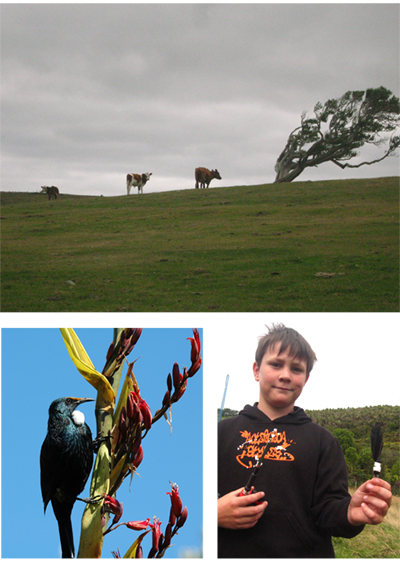
The Chatham Islands murderous wind; the super-sized Chatham Island tui & the transmittter which tracks each of the birds post-release.
Weta -eating spiders the size of your fist, supersize tui, spike-free lancewood, and over 160 endemic species of insects call this archipelago home, however the majority of these unique species can only be found on the three small, inaccessible offshore islands that surround the mainland.
These very islands hold almost 20% of New Zealand’s threatened bird species (Black Robin, Forbes Parakeet, CI Mollymawk, CI Snipe, CI Shore Plover), but with the hard work of two conservationists these species may stage a return to the main island.
Here to bear witness to the transfer of CI tui onto the main Chatham island after a 25 year absence, I point my jeep in the direction of the Southern tip where the 14 birds are being held pre-release. It only takes a drive through the countryside to see why birds & plants find this land inhospitable.
Large stretches of farmland and patches of bracken fill my window, punctuated by the odd tree set at a 45 degree angle. Farmers removed much of the island’s historical artefacts (Moriori tree carvings) and unique natural heritage* one hundred and fifty years ago by cutting great swathes of forested land, and converting it to farmland.
Now just a few forested patches remain, and the salt-laced, corrosive and sometimes murderous winds, have destroyed exposed parts of these remnants leaving tree cemeteries on their borders.
Rolling up to the tui’s holding aviary in the Awatotara, I was expecting to wowed by their size, but it was their song that struck me. Their staccato three-part harmony ended in a crescendo, that was followed by what is best described as a whooping sneeze.
Chatham Island Tui Transfer 2009 from Mandy Herrick on Vimeo.
‘These birds have the flu. Bird flu!’ joked one of the translocation managers, Mike Bell. In the next few hours the birds were blessed and sung to in all variety of languages – English, Maori and Moriori, before the door was opened onto the lush 70 hectare reserve filled with fruit-bearing trees.
Having snacked on these forest fruits, twelve tui flew in formation above the reserve to the delight of those watching , then ducked into the valley below.
Tui fly great distances in any one day and have known to travel from Invercargill to Stewart Island for a piece of prized bit of tucker, so if all goes to plan they could potentially re-colonise the island, with re-planting and pest control by the locals.
The return of this iconic species was funded by Forest & Bird’s international partner Birdlife international, but the real work started 16 years ago, when Liz and Bruce first began re-planting pockets of their farmland.
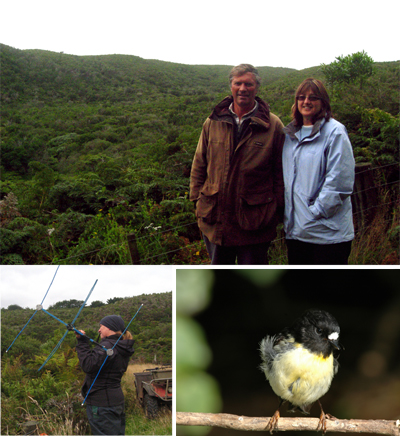
Bruce & Liz in front of the tui's new home; Elizabeth bell locates the tui post-release & CI tomtit, one of the species the couple plan to introduce
Two hundred and thirty hectares of their land has now been set aside as a homeland for endemic species struggling to survive, providing ample inspiration for locals wanting to see the return of their native birds.
Already the Tuanui’s share their property with Taiko (nationally critical), CI oyster-catchers (nationally critical), CI wood-pigeon (nationally critical), Pitt island shag (endangered), CI petrel and CI warbler (both nationally vulnerable), however they’re looking to introduce many more – sooty shearwaters & CI tomtit to name a few.
Just before I leap back on my plane I check in on the tui, and all of them are settling in very well, so as I set off to Wellington, I compile a list of the new population on the main Chatham island.
Here’s my very, very rough tally of some of the inhabitants (feathery and otherwise) -
14 CI tui
200 parea (CI wood pigeon)
150 taiko
12,000-10,000 black swans
Untold weka
Untold sheep + cattle
600 - 650 human inhabitants
1 flying hairdresser**
1 police-officer
Let’s hope next time when I return there will be many more endemic feathery inhabitants on the mainland. No doubt, with the vision and muscle of people like Liz and Bruce the Chatham Islands will be dotted with bird-filled forests.
*15 endemic birds have gone extinct in the past 500 years
** The hairdresser flies in every month.
Please feel free to add to this list by posting a comment below!

Sounds amazing, I’d love to visit the Chathams.
Enjoyed the article. There’s a lot going on on the Chathams. It’s a special place with special people, Between them, DOC, the Taiko Trust and private landowners have made some real advances but more remains to be done. Look up http://chathamheritage.org.nz - it’s the website for Chathams Heritage and Conservation Trust, recently set up by a group of islanders.
Yesterday, a week after release, all the tui were still in the Awatotara covenant and were seen feeding on the honeywater left out for the birds. Well done Bruce and Liz for years of dedication to the conservation of your very special corner of the world.
It is great that this worked was funded from the Birldlife International Community Conservation Fund set up by Sarah and David Gordon from the UK . They have fallen in love with New Zealand and Pacific birdlife and have committed 50,000 UK pounds for 5 years to help species recovery. This really does demonstrates the power of Birdlife partnership working with local communities to make a real difference for species recovery throughout the world.
Good to see that you’re helping to save some of the 1,227 globally threatened birds. In fact the Chatham island petrel even gets a mention in this article for staging a comeback -
http://www.sciencedaily.com/releases/2009/05/090513224124.htm
Good news folks - seven months on and the tui are settling in brilliantly - here’s word from Mike Bell.
All 14 tui are still alive, and still in the general release area. An additional non banded bird has also joined the group and is using the sugar water feeders. All the birds are regularly visiting the feeders. Some birds have shifted to the Kringe (this is the valley where Bruce and Liz’s house is), and some to the Tuku Valley but all travel to the old aviary to feed on the sugar water.
One pair has been seen copulating, so early signs are positive that the birds will breed this year. It does not look like it is going to be a great flax flowering year, but perhaps the sugar water and greater diversity of food available will still enable the birds to breed (In a study on Rangitira Island it was showen that tuio breeding was entirely linked to flax flowering). The birds dispersing out a bit may also be as the birds pair up and form breeding territories.
The locals are still keenly interested in the where abouts of the birds and regularly ring Bruce and Liz for updates. This project has definitely increased the understanding of community driven conservation awareness on the Chatham’s. In my 20 years experience in the Island’s I have never seen Islanders so keen on helping to save birds.
Any more news this year? I beleive more Tui have been released?
Our daughter ( from Massey Uni ) is doing some reasearch on the Tui on Rangatira and Pitt Island this month ……and its hard to get news here in the UK!
Hi Sue
Yes the news is all good. We transferred a further 39 birds in Feb, and they have despersed all over the Island. The first crop of young have just fldeged from Nests this year, and the females are going down on another crop of eggs. It is an amazing flax flowering year this year, so breeding will probably be very productive. The Taiko trust at this very moment are doing a survey to identify how many birds survived the winter and how wide spread they are. All very promising signs so far. The Islanders are reporting tui from all across the island, with many people noting breeding in their property, the Islanders are still very excited about seeign tui, it has made a real difference to many peoples lives.
We are planning a tomtit transfer this Feb too!
Here’s the latest from Mike - sounds like they’ve been welcomed with open arms by the community. Nice.
The tui project was unique in the Chatham’s - it was the first time that a major conservation project was planned and led by locals. The Taiko Trust involved locals in both transfers, with over 15 locals helping out with some aspect of the project – helping to catch birds, transport birds (by boat or car), feed birds or radio track birds post release. Over 100 people were there to witness the second release!
As the birds started moving around the island the calls started flooding in. Firstly people were reporting sightings – some older residents were in tears as they told us they had tui in their garden for the first time in forty years. Then people wanted to know what they could feed the birds to attract them, and what plants they should grow to encourage them to stay. When tui started breeding people called in wanting to know what they should do to protect them. At least 12 households are still now putting out sugar water each day in their gardens, and four large landowners have started carrying out possum control to improve forests on their farms for tui.
Although we haven’t kept accurate records, we estimate that we now get 120-150 calls a year, mostly about tui but also increasingly about a range of environmental issues. People are becoming far more aware of the natural world around them. More people are volunteering to help us, and more landowners are keen to see conservation work happen on their property. There is a growing realisation that they themselves can look at getting some of the missing species back.
Remember that the Chatham’s only has a population of 600, so when you consider these figures in terms of calls or volunteers per capita then this project has been an outstanding success community wise also. I tend to feel that often this community side is forgotten about, and the biological success become the priority. I have been involved in conservation in the Chatham’s for over twenty years, and I have never seen things looking so positive. I feel the future is looking decidedly exciting!